
‘A Hawaiian son’: Honolulu honours Sun Yat-sen as his landmarks vanish
Few buildings the revolutionary leader knew in Honolulu survive, but descendants of families who funded his cause are keeping his legacy alive
Teresa Elena Frontado in Honolulu
Published: 9:34pm, 11 Oct 2026 / Updated: 9:34pm, 11 Oct 2026
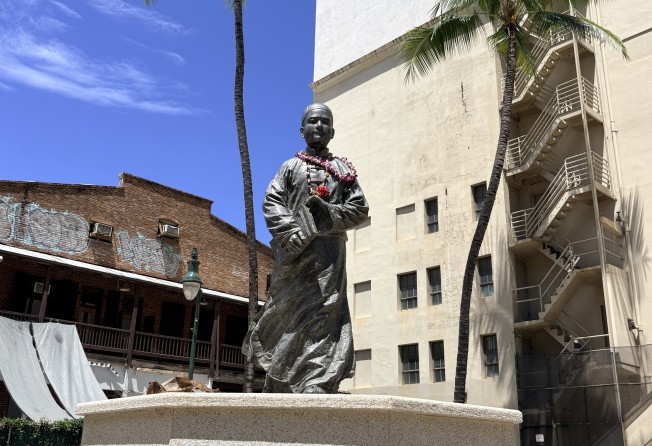
A statue depicting Sun Yat-sen at age 13, created by Hong Kong sculptor Chu Tat-shing and donated to Honolulu by the Sun Yat-sen Hawaii Foundation in 2007. Photo: Teresa Frontado
Eddie Flores pressed the button at a pedestrian crossing on King Street, then pointed across the road.
In the spring of 1910, Chinese revolutionary Sun Yat-sen lodged over there, on the second floor of a shop owned by a friend and fellow party member.
“It’s no longer there,” said Flores, chairman of the restaurant chain L&L Hawaiian Barbecue. “But we can more or less point out where the building is.”
Much of Sun’s Honolulu has to be found this way. The church where he worshipped as a boy was pulled down in 1909. The basement where his followers met in secret was lost in a renovation. The theatre where he called for the overthrow of the Qing dynasty’s autocratic rule is now a market. And the place where China’s first revolutionary party was founded is a car park.
On November 24, 1894, about 20 men gathered there, on Emma Lane, first in the house of a bank clerk named Ho Fon and then in the house next door. They formed the Hsing Chung Hui, or Revive China Society, and pledged to bring down the Qing dynasty. Their leader was a 28-year-old doctor who had gone to school a short walk away. Both houses were demolished in the 1960s.
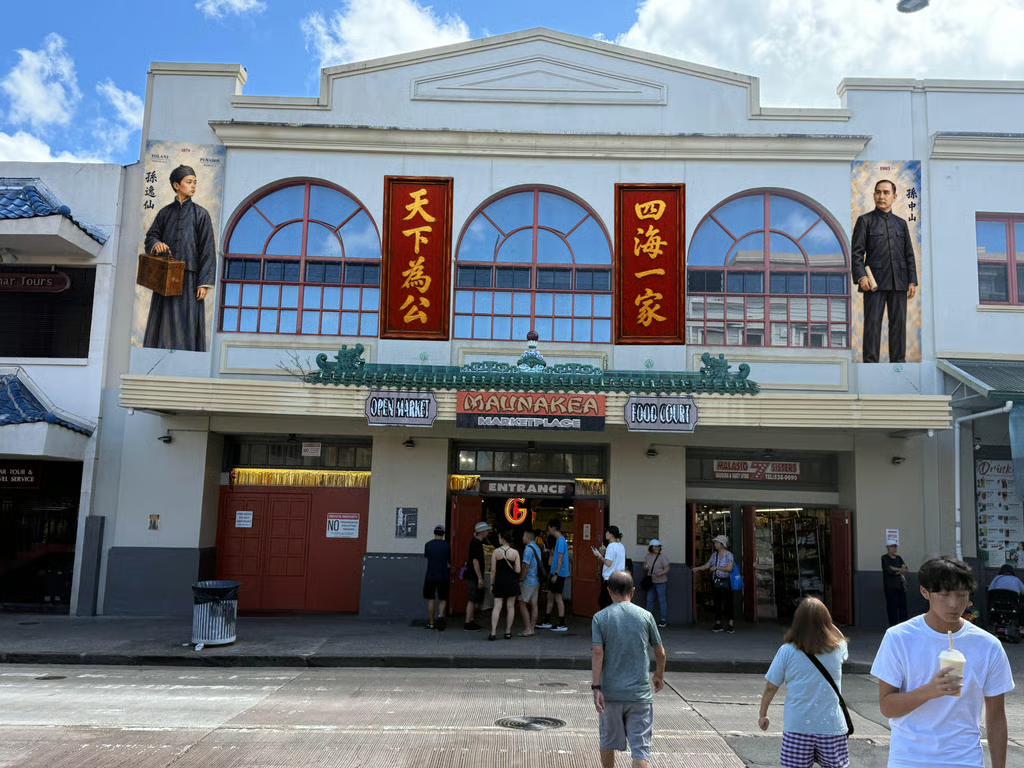
An artist’s rendering of Jessika Tseng’s mural planned for the facade of Maunakea Marketplace, the former site of the American Theater, where Sun Yat-sen called for the overthrow of the Qing dynasty in 1903. Photo: Handout
The families of the men who housed and funded him are still here. They treat his years in the islands as their own history, and they are proud of it.
On November 1, Flores and a committee of Chinese-American community leaders will lead the public along that route to mark the 160th anniversary of Sun’s birth. The programme includes walking tours, a lei-draping at a statue of Sun as a 13-year-old, the unveiling of a mural and a banquet in Chinatown hosted by the Chinese Chamber of Commerce. Where a building is missing, a guide will stand in for it. Hawaii’s governor and Honolulu’s mayor have been invited, along with representatives from China.
Flores, who was born in Hong Kong, is of Chinese and Filipino descent and a long-time supporter of causes in both communities.
“We consider him to be a Hawaiian son, just like Obama,” Flores said, referring to former US President Barack Obama. “Obama was born here, went to school here.”
Sun was born on November 12, 1866, in Cuiheng, a village in Guangdong province. But he once said otherwise, and it got him into the United States.
The birth certificate
Warren K.K. Luke, chairman of the Dr Sun Yat-sen Hawaii Foundation and chief executive of Hawaii National Bank, told the story this way. In 1904, when Sun sailed to San Francisco to raise money for the revolution, immigration officers stopped him under the Chinese Exclusion Act, the 1882 law that barred Chinese labourers from the country.
“He said, ‘Well, I’m Chinese, but I was born in Hawaii,’” Luke said. “And he showed them his Hawaii birth certificate, and they said, ‘OK, you’re OK.’”
It was not the first time. According to historian William Zanella, in a paper published by the foundation, Sun reportedly persuaded the American consul in Yokohama in the 1890s to issue him a passport on the same claim.
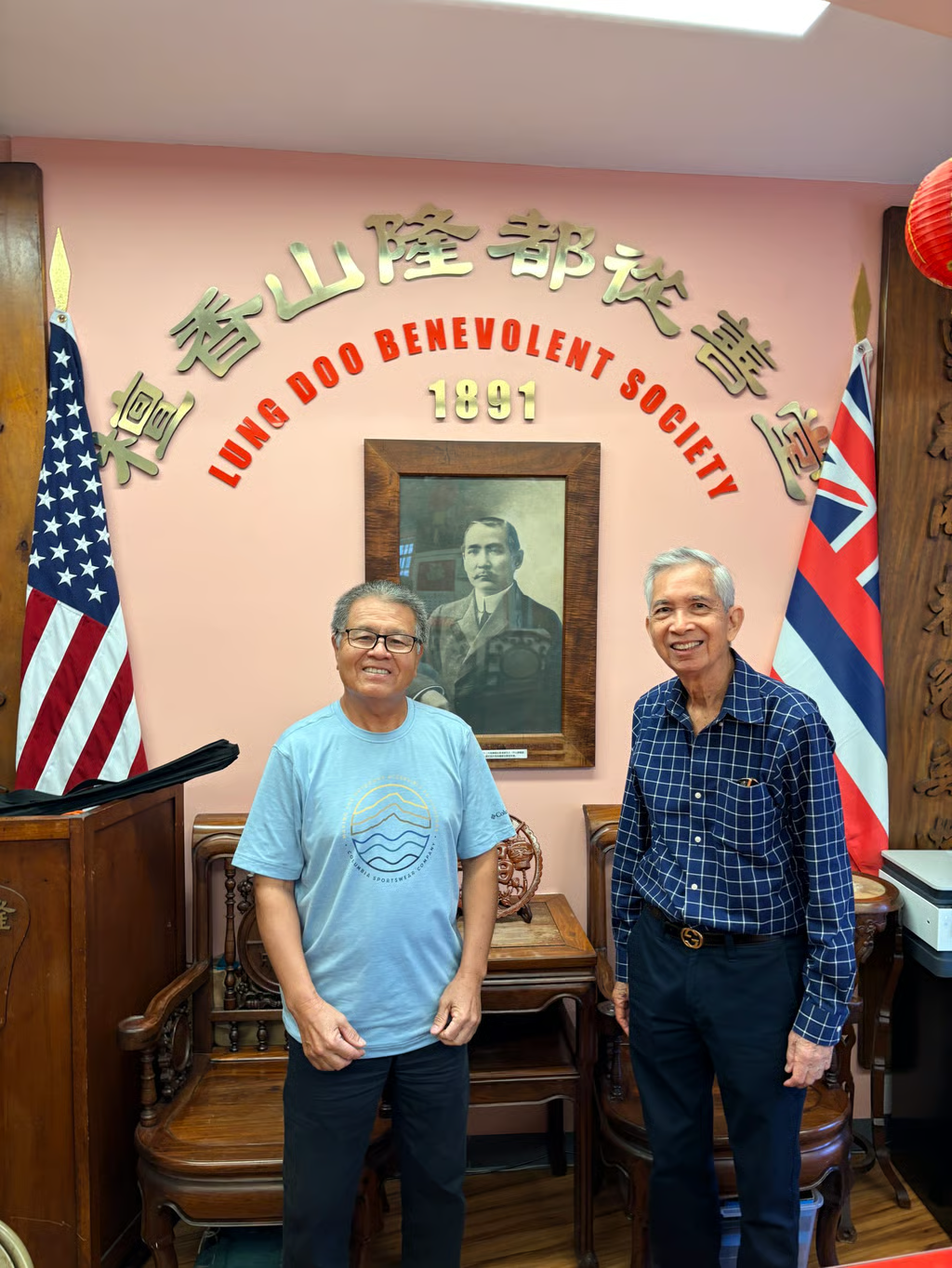
Eddie Flores (right) stands beside a portrait of Sun Yat-sen given to a member of the Lung Doo Benevolent Society in Honolulu’s Chinatown. Photo: Teresa Frontado
The certificate resurfaced more than a century later, Luke said, when people who doubted Obama’s Hawaii birth pointed to it as proof that the islands’ records could not be trusted.
The Exclusion Act was not repealed until 1943. Luke said his own father, a Hawaii-born student in Boston, had to register his birth to be sure of getting home.
He sees an echo now. Hawaii, he said, was where people of different backgrounds learned to work together, and it was once held up as America’s natural bridge to Asia.
“We were getting to the point where everybody would work together, and now we’re going through isolationist policies,” Luke said.
‘We’re all Zhongshan’
Sun first came to Hawaii at 12 or 13, when it was still a kingdom, to join an elder brother who had prospered as a merchant and rancher on Maui. Over seven visits he spent years in the islands.
He was among neighbours. Most of Hawaii’s early Chinese came from the same county on the west bank of the Pearl River Delta, then called Heungshan. After Sun died in 1925 it was renamed Zhongshan, the name by which he is known in Chinese.
“My grandfather was a supporter, but so many others in Hawaii were supporters of Sun Yat-sen as well,” said Wing Tek Lum, a Honolulu real estate executive. “The primary reason is that we’re all Zhongshan.”
Family memory holds the details. When Sun spoke in public, Lum said with pride, his grandfather carried out the table and brought him a glass of water. Later, at Sun’s urging, he said his grandfather helped found a Chinese-language school that was eventually renamed for him.
The family has another connection to the trail. The Lum Yip Kee Building at 88 King Street, which belongs to Lum’s family, housed a shop in 1910 whose basement Sun’s followers used for secret meetings.
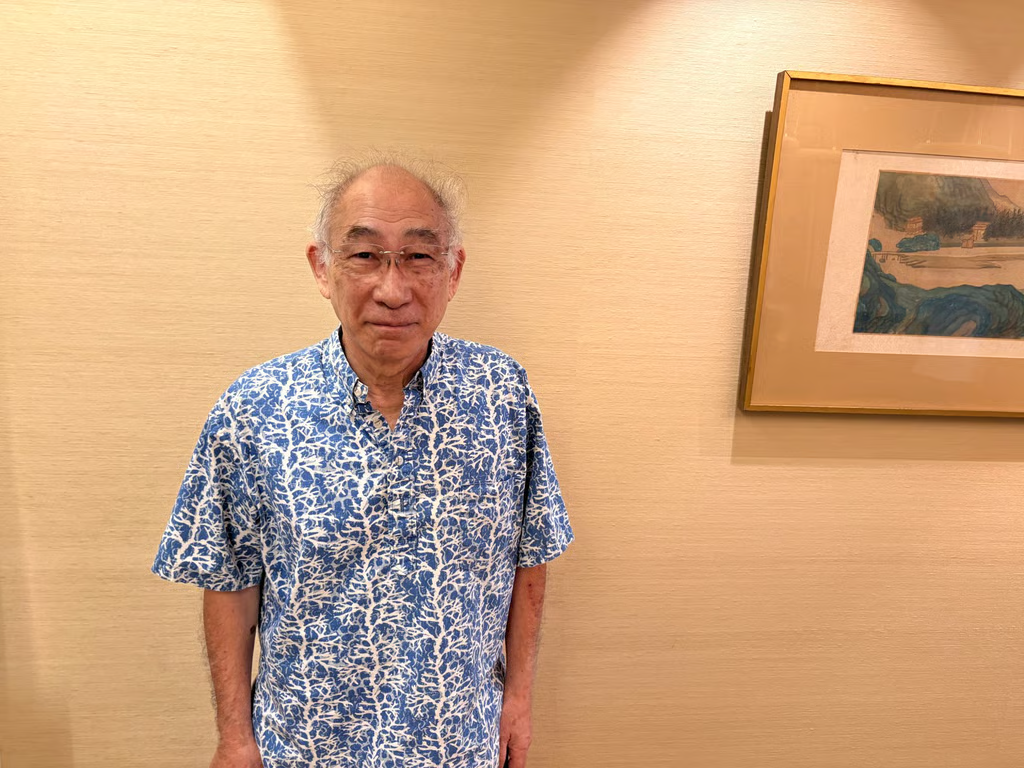
Wing Tek Lum’s grandfather supported Sun Yat-sen fundraising and recruiting efforts in Hawaii. Photo: Teresa Frontado
“It’s not just one person that created this revolution,” Lum said. “There are a lot of people involved. People going back and forth, back and forth.”
Luke’s family has its own record. His wife’s grandfather gave money to the cause, he said, and kept the receipts Sun’s organisation issued in return.
Chinatown’s district societies keep the memory too. The Lung Doo Benevolent Society was founded in 1891 by migrants from one part of Zhongshan. At the head of its meeting room hangs a black-and-white portrait that members say Sun gave to one of their own. It sits in a dark wooden frame between the American flag and the flag of Hawaii, above a pair of carved chairs.
A wavering base
Sun’s support in Hawaii was never as steady as it is remembered. Flores said the whole community “supported him wholeheartedly”. Historians describe something slower and more divided.
It began small. Honolulu had about 5,000 adult Chinese men in 1894, and only about 20 of them came to the founding meeting of Sun’s society, according to Zanella, the historian.
Then it nearly collapsed. In 1900, Liang Qichao, a prominent reformer who had fled China, came to Hawaii to recruit for a rival cause. Sun wanted to replace the emperor with a republic. Liang wanted to keep the emperor, under a constitution. Within six months about 90 per cent of Hawaii’s Chinese had joined Liang’s side, including Sun’s own brother.
Sun returned in 1903 and won many of them back, speech by speech. One, on December 13, drew hundreds to the American Theater. The site is now Maunakea Marketplace, entered through a green-tiled gate flanked by stone lions, and it is where the new mural will be unveiled.
By 1910, his rallies in Honolulu drew thousands, and more than 800 people joined his party. The enthusiasm faded again within months. When he wrote asking for money, most members did not answer, and by the end of that year only about 30 were still active.
Lum acknowledged the split. Many local Chinese “unfortunately” supported the monarchists, he said.
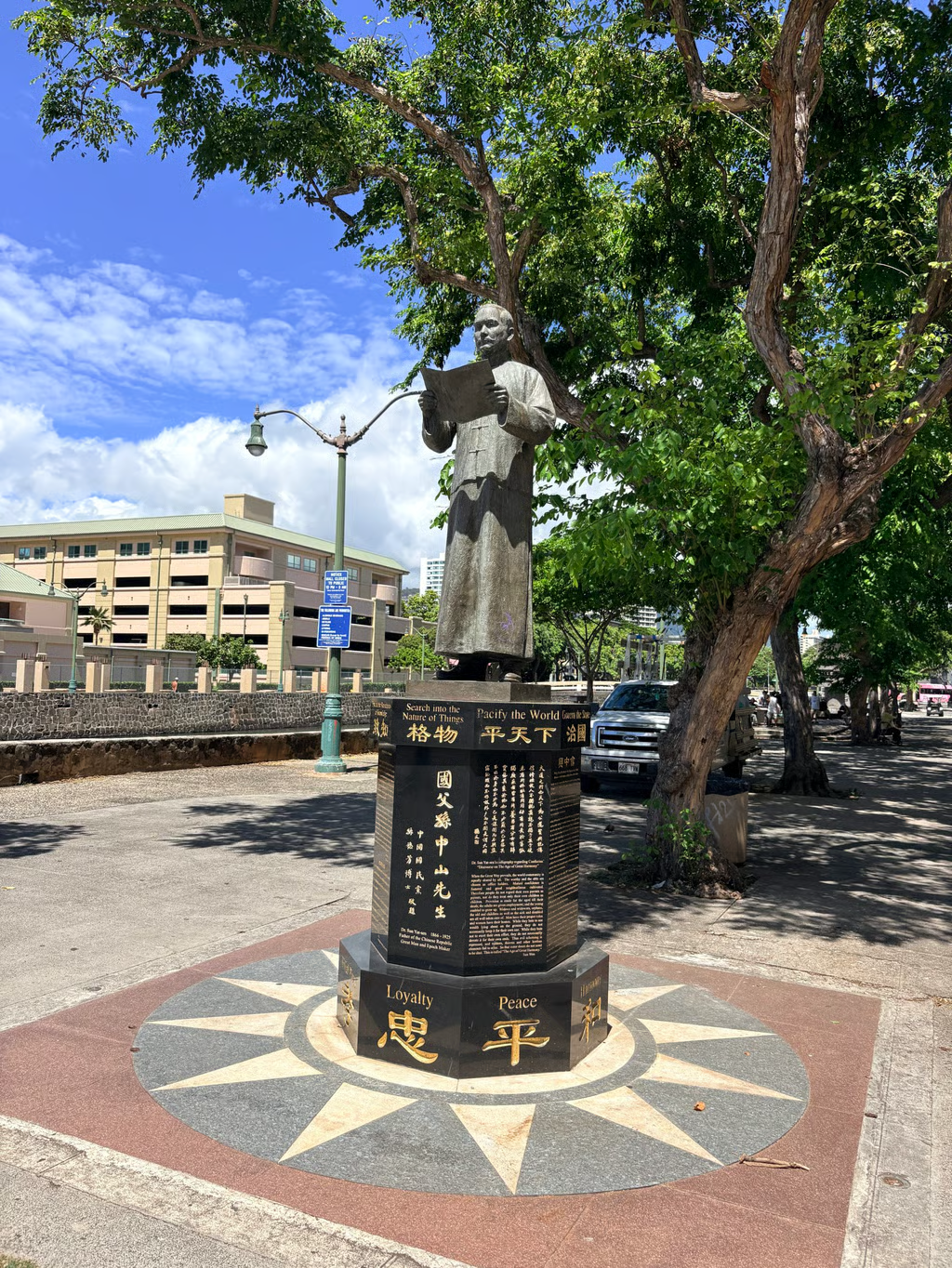
A statue of Sun Yat-sen holding the declaration of the Revive China Society at Honolulu’s Chinese Cultural Plaza. It was donated by the people of Kaohsiung, Taiwan, in 1984 to mark the society’s 90th anniversary. Photo: Teresa Frontado
The memorials carry their own politics. The statue of Sun as a boy, given to the city of Honolulu in 2007, is the work of Hong Kong sculptor Chu Tat-shing. It stands in a small fenced park beside the Hawaii Theatre, where a city sign bans camping, alcohol, open fires and, oddly for a paved plaza, golfing and says the park is closed at night. The statue is often draped with lei. In September it wore at least two.
At the other end of Chinatown, 10 minutes on foot, a bronze of the adult Sun in a long gown holds up the society’s declaration, on a base inscribed with Confucian maxims in English and Chinese. It was donated in 1984 by the people of Kaohsiung, Taiwan. In September, a purple scrawl marked its robe, and many homeless people gathered in the area around both statues.
The committee is also looking past its own generation. A statewide essay competition on Sun is open to Hawaii’s high school and college students, and the winners will be recognised as part of the November 1 festivities.
The last classroom
Even the question of where Sun became a revolutionary is contested, politely, between two of Honolulu’s best-known schools.
He spent three years at Iolani, then an Anglican school run by British teachers loyal to the Hawaiian crown. In 1882 he took second prize in English, handed to him by King Kalakaua. When Sun became notorious in 1896, the school’s bishop wrote that he had learned no republicanism there.
He then spent some months at what is now Punahou, founded by American Protestant missionaries. Obama graduated from the same school in 1979. Flores said Punahou likes to boast that it educated two presidents: one of the United States and, in Sun, the first provisional president of the Republic of China. Luke believes that is where he read about Abraham Lincoln and George Washington. Flores, who is overseeing the mural, put both schools on it.
“I have to be diplomatic,” he said. “I got to be on both sides.”
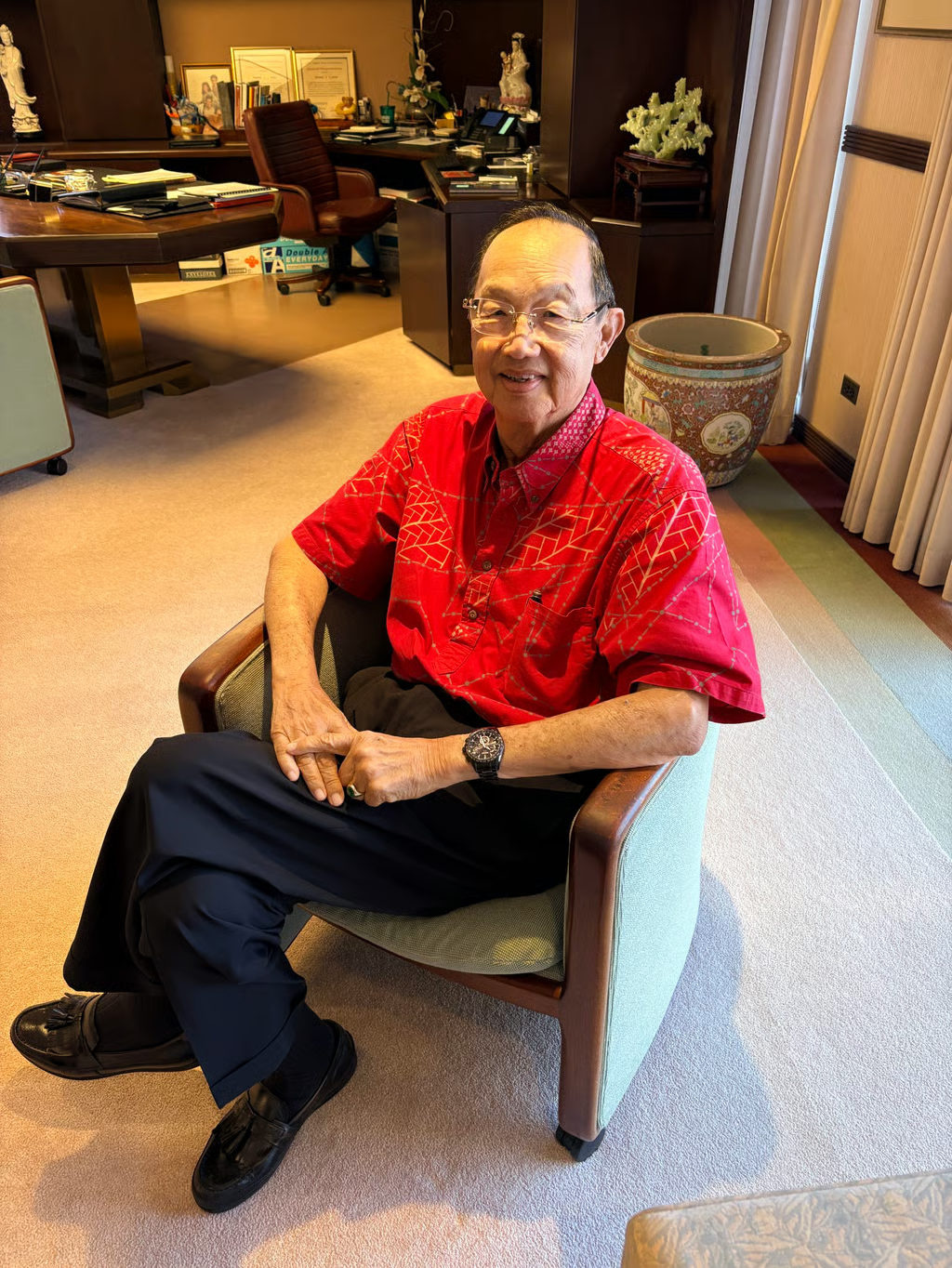
Warren K.K. Luke’s family kept Sun’s receipts and papers that they have donated to the Sun Yat-sen Hawaii Foundation. Photo: Teresa Frontado
Punahou has one advantage, and it is the rarest thing on the Sun Yat-sen trail: a building. The hall where Sun took his lessons, built in 1851, is still used as a classroom, Luke said, with a plaque on the wall.
“Everybody from China comes,” he said. “They want to go take a picture.”
The rest of the trail will have to be imagined on November 1. Guided tours will leave every 15 minutes through Chinatown, with guides doing what Flores did on King Street: stopping and pointing.
At 10am, community leaders will drape fresh lei on the statue of the boy. Then the crowd will walk to Maunakea Marketplace, where the American Theater once stood, to unveil the mural.
Draft designs by the artist Jessika Tseng, shared by the organisers, show two tall panels on the market’s facade. On one, Sun is a boy in a long blue gown, arriving in 1879 with a trunk in his hand, beneath the names of both Iolani and Punahou. On the other, he is the grown revolutionary of 1903, a rolled paper in his fist. Between them, in gold characters on red, is his best-known motto: the world belongs to all.
So, by now, does Sun. Beijing honours him as a forerunner of the revolution and Taipei as the father of the nation. A Hong Kong sculptor made one of his Honolulu statues and the people of Kaohsiung gave the other. Two schools each count him as their own.
On November 1, Chinatown will renew its claim: a Hawaiian son.
Source
South China Morning Post, 11 October 2026.
By Teresa Elena Frontado.
Article text and images extracted directly from the supplied PDF.
Copyright © 2026 South China Morning Post Publishers Ltd. All rights reserved.